Implants

In recent decades, modern dental implants have become the most appropriate therapeutic approach in many cases for the restoration of lost natural teeth. Success rates are close to 98% in the lower jaw and 95% in the upper jaw for 15 years, with documented scientific research spanning more than 50 years.


The specialized training of our clinic’s associates in implant surgery, combined with our extensive surgical experience in the field of oral and maxillofacial surgery, enables us to successfully treat everything from the simplest problems of tooth loss to the most complex ones, where, in addition to the absence of most or all of the natural teeth, there is also significant bone loss. Furthermore, our ongoing collaboration with prosthodontists or referring dental colleagues for prosthetic restoration ensures, on the one hand, the use of the most modern methods of immediate implant placement and immediate loading of the prosthetic work, whenever and wherever possible, and, on the other hand, the longevity of the result with excellent aesthetic and functional results.


Our clinic has been placing dental implants for almost 30 years, always choosing companies that are recognized and respected in the dental community, thus ensuring consistent material quality and, consequently, safety and confidence in the final results. The implants come with a certificate of authenticity, which is given to the patient after placement.

1
1
2
2

What is an implant


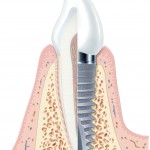
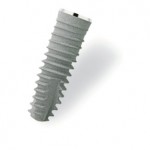
A modern dental implant is a cylindrical titanium structure that is surgically placed in the upper or lower jawbone through a simple procedure, essentially simulating and replacing the root of the lost tooth. It is available in various lengths and diameters and is selected according to the anatomical conditions of the area. (Fig. 1) The implant restoration procedure usually consists of two phases, the surgical and the prosthetic.


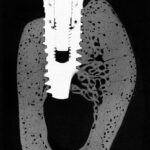
The implant is surgically placed in the jawbone and its specially treated surface has the unique ability to bond with the bone over the following months, in a process called osseointegration. This takes 2 to 6 months and is the basic mechanism that ensures the long-term success of the result. (Fig. 2)


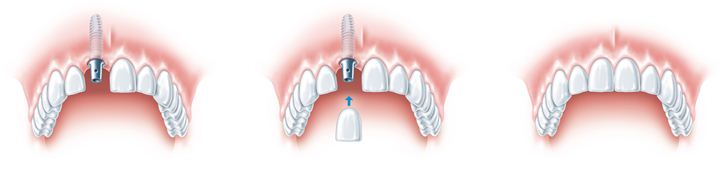
Once osseointegration has been achieved, a titanium metal structure resembling a ground tooth (abutment) is placed on top of the implant, followed by the final prosthetic restoration (crown-bridge), which is identical to that of conventional prosthetics. (Fig. 3)

3
3

Benefits of dental implant treatment for patients


If you have lost or are about to lose some teeth with implants you:


• immediately replace lost or damaged teeth, so that the function and aesthetics of your mouth are not affected and the remaining teeth that are not used in the replacement are protected.
• keep the bone healthy by transmitting chewing forces through the implants.
• avoid the gradual loss of your remaining natural teeth and the future need for major prosthetic restorations.


If you use full or partial dentures by replacing them with implants:


• Your articulation and speech return to normal, just as with your natural teeth.
• You can eat all foods and improve your chewing ability, resulting in better digestion and food absorption.
• Your face and smile are noticeably improved.
• You feel socially comfortable and confident.

Advantages of implant treatment. Absence of one or more teeth


In traditional prosthetics, to cover the gap created by the loss of one or more teeth, a fixed (bridge) or removable (denture) prosthesis is constructed, supported by adjacent teeth. The jawbone at the sites of the missing teeth gradually resorbs since the stimulus transmitted through their roots is no longer present.


The aesthetic and functional results with fixed restorations on natural teeth are certainly very satisfactory, but it would be best to prefer them only in cases where the adjacent teeth already have some pathology (e.g., they have large restorations, they have undergone endodontic treatment), and not when it comes to intact healthy teeth, as it is necessary to grind them and consequently weaken them.


The removable construction gives very poor aesthetic and functional results, is difficult for the patient to tolerate, at the points where it rests on the gums, it exacerbates bone resorption, and statistics show that 30% of adjacent teeth in a removable prosthesis develop problems within seven years.


4
4

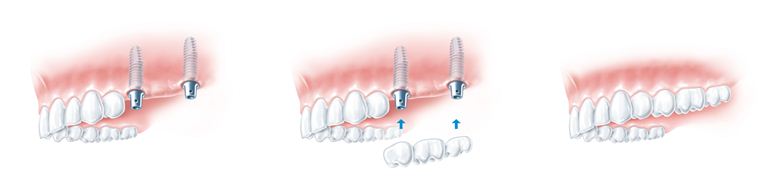
The restoration of one (Fig. 4) or more (Fig. 5) teeth with dental implants offers excellent functional and aesthetic results without affecting adjacent teeth or gums, while chewing forces are transferred through the implants to the bone (as with natural teeth), thus preventing bone resorption. Statistically, implants have a 15-year survival prognosis if scientifically documented protocols are followed by both doctors and patients.

5
5

Advantages of implant treatment. Absence of all teeth


The loss of all teeth is treated by classic prosthetics with the construction of full dentures (dentures). In the upper jaw, their retention is satisfactory, but they are usually bulky constructions that make it difficult for the patient to speak and chew and cause intense bone resorption and/or gum hyperplasia at the points of support. In contrast, in the lower jaw, the small bone surface of the lower jaw and the mobility of the tongue and floor of the mouth make their retention very difficult, resulting in many patients not using them at all because they cannot speak or chew. These are relatively inexpensive solutions, but they have many functional and aesthetic problems.


The restoration of all missing teeth with dental implants can be done either with a fixed independent unit or with a removable one.

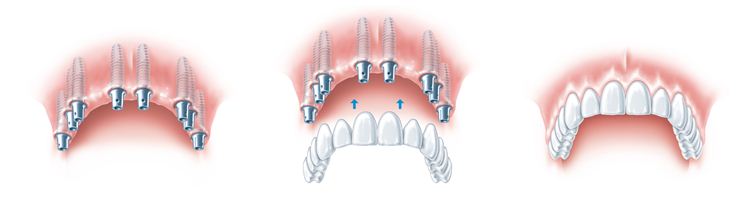
The fixed construction is based on the appropriate number of implants for each case (usually 6) and covers as much of the upper or lower jaw as possible. It is completely fixed, offering absolute functional and aesthetic satisfaction to the patient, who has a similar feeling to that of their lost natural teeth. (Fig. 6)

6
6
7
7

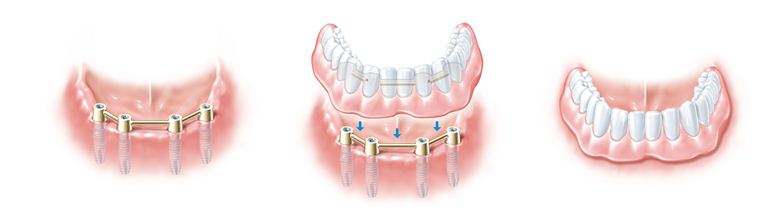
The removable construction for the upper jaw is supported by at least 4 implants. is significantly smaller in surface area than a conventional denture, is extremely stable, very satisfying aesthetically and functionally and helps preserve bone.


The placement of a removable construction on four implants in the lower jaw has all the advantages mentioned above for the upper jaw. (Fig. 7) However, it is possible for the prosthesis in the lower jaw to be supported by only 2 implants. In this case, while maintaining sufficient mobility, it remains anchored to the implants, allowing the patient to speak and chew. It is a simple and more economical solution, but one that significantly changes the patient’s quality of life.

Implantation procedure


Implants are usually placed under local anaesthesia in our specially equipped clinic, thus ensuring their safe and quick placement and minimising post-operative complications.


Modern local anesthetics offer reliable, deep, and long-lasting anesthesia and are not at all harmful to general health, making the entire procedure completely painless and safe.


The duration of the procedure depends on the number of implants to be placed, but in any case, the patient’s discomfort is less than that of a classic dental procedure of similar duration.


The surgeon creates appropriate sockets in the bone in which the implants are placed and then usually covers them by closing the gums (Fig. 8) unless an immediate loading protocol is followed.


The time that the implants must remain in the bone without being subjected to forces in order for the osseointegration process to be completed is 2-3 months for the lower jaw and 4-5 months for the upper jaw. The variation in time depends on the quality of the bone, the stability of the implant during placement, the use or non-use of grafts to restore bone defects, the age and general health of the patient.


For the period from implant placement to tooth placement, the patient is covered functionally and aesthetically with some transitional structures that either rest on existing teeth or are in the form of dentures or, as we will mention below, supported by the implants.

Immediate placement


In selected cases, the removal of one or more teeth can be combined with the immediate placement of one or more implants in their place, thus saving the 2-3 months needed for the bone to heal and become suitable again for receiving an implant.


Depending on the case, special healing screws can be placed (Fig. 9) or even temporary teeth out of occlusion so that no forces are transferred to the “buried” implants, which are in the osseointegration phase for the next 2-4 months. (Fig. 10)


In any case, the patient’s postoperative course is smooth, with mild edema (swelling) and pain, which are completely controlled with appropriate medication and subside completely within 4-5 days.


In cases of procedural complexity and, consequently long duration, or in cases of increased patient anxiety, the operation can be performed with the aid of sedation or even general anesthesia, always in a clinical hospital setting.

Prosthetic restoration procedure


Once the appropriate period of time has elapsed, as mentioned above, the process of manufacturing and placing the teeth on the implants begins. After taking an impression, the abutments, i.e., titanium structures specially adapted in the laboratory, which resemble the ground parts of the teeth before the placement of classic prosthetic work, are placed (screwed) on the implants. The permanent teeth are fabricated and placed on top of these using the same procedure as for the fabrication of a conventional denture or bridge.


If a removable prosthesis is planned, special structures are placed on the implants that snap into the corresponding “female” structures placed on the removable prosthesis, thus ensuring both the stability of the prosthesis and the ability of the patient to remove and clean it.

Immediate loading


In selected cases and under strict criteria, an impression can be taken immediately after the implant placement and temporary teeth can be fabricated and placed immediately. At a later stage, depending on the factors mentioned above, permanent teeth are manufactured and placed.


This technique, called “immediate loading,” is extremely attractive as the patient gets teeth in just a few days instead of several months. Essentially all stages of implant restoration, instead of taking the conventional 5-6 months, are completed within a week and patient satisfaction is extremely high. However it is not a method that can be applied in all cases, and it must be understood that only careful selection of cases with scientifically documented strict criteria ensures the same long-term success as the conventional method.

What happens when there is not enough bone to place an implant?


Obviously, the successful placement of an implant requires sufficient healthy bone in both height and width.


Chronic inflammation (a tooth that has been causing discomfort and has been loose for a long time), prolonged tooth loss, and the use of poor prosthetic devices lead to slow but continuous resorption of the jawbone. In order to place implants in such a problematic substrate, this deficiency must first be restored using various reconstructive techniques.


Thus, when we want to increase the thickness or height of the jaw at a problematic site, we use various grafting materials that can be either from the patient himself (autograft), or processed bone graft from another person (allograft), bone graft from other species (xenograft) (bovine, porcine, etc.), or synthetic bone (biomaterial) (alloplastic graft).


Autografts are usually collected from suitable areas inside the patient’s mouth (chin or the posterior region of the upper or lower jaw) and very rarely (mainly in cases of large defects) from other sites outside the mouth (iliac crest, tibia, skull). Often, in order to eliminate or reduce the extent of the surgery required to obtain the graft, we use ready-made grafts. These grafts are either processed bone grafts from another human being or bone grafts from other species (bovine, porcine, etc.) or synthetic bone (biomaterials) and undergo a thorough sterilization process and destruction of any antigenic properties to make them completely safe and easy to use. Both biomaterials and processed grafts have the exact structure of human bone and serve as a “scaffold” for the patient’s body to create bone. They come in the form of granules, paste, or blocks, can be used in any case of bone augmentation, and are almost fully absorbed after a certain period of time.


Another regeneration technique for the upper jaw is sinus floor elevation. In this technique, the sinus membrane is moved higher, a graft is placed, and then the implant is placed either immediately or at a later date.


There are now many new techniques, such as the use of zygomatic implants, subperiosteal custom-made titanium mesh, and others, which due to their complexity and difficulty are used in a few selected cases with extensive bone defects.


Based on our experience, we choose the bone regeneration technique and the type of graft depending on the location and size of the bone loss, with the basic criterion being the simplest procedure for the patient with the most stable result.

How we ensure high success rates


The success rates of modern implants are among the highest for medical procedures. To consistently achieve such excellent results for our patients, we adhere to a series of well-established guidelines. These protocols are designed to maximise both the longevity and the functionality of dental implants, whilst prioritising patient safety and satisfaction.


1. The implants we use are sourced from reputable, large-scale manufacturers with an extensive background in research and production. This guarantees a high standard of quality and ensures that only the most advanced materials are utilised.


2. We conduct thorough planning for both the surgical and prosthetic phases before commencing any treatment. This process involves close collaboration with specialist prosthodontists and referring colleagues, enabling us to tailor each case to the individual needs of the patient.


3. We carefully determine the most suitable surgical technique, as well as the type and timing of the prosthetic restoration. Our decisions are always guided by the patient’s best interests and are firmly rooted in scientifically validated protocols.


4. We ensure that each patient is fully informed about the necessity of maintaining meticulous oral hygiene for the lifetime of their implants. Ongoing supervision and regular dental check-ups are essential for long-term success, and patients are supported throughout this process by their dentist’s guidance.

Which patients are suitable for implants?


ΣImplants can be placed in any patient regardless of age, provided they are in good general and oral health.

For which patients are implants contraindicated?


1. Patients who suffer from chronic illnesses and are undergoing treatment with immunosuppressive medication.


2. Patients receiving chemotherapy.


3. Patients undergoing radiotherapy to the facial area.


4. Patients with severe psychiatric disorders.


5. Patients with serious cardiac or respiratory conditions when extensive restorations requiring prolonged surgical procedures are needed. However, for these patients, shorter procedures involving the placement of a small number of implants can be safely performed after suitable preparation.


6. Patients with uncontrolled diabetes mellitus. Conversely, those with well-controlled diabetes may safely receive dental implants, provided they maintain exceptionally thorough oral hygiene.


7. Patients who have taken oral bisphosphonates for osteoporosis for more than three years should discontinue their use for three months prior to implant placement. If taken for less than three years, it suffices to stop for the duration of placement and healing. For patients taking “Prolia” or similar injectable medications, any surgical procedure should ideally be scheduled towards the end of the six-month dosing interval. If possible, the medication should be paused during the period required for the implant to integrate with the bone (osseointegration). For those on injectable bisphosphonates, dental implants are contraindicated Osteoporosis itself is not a contraindication.


8. Smoking is not a formal contraindication, but it is certainly a complicating factor. Robust scientific evidence now demonstrates lower success rates among smokers; therefore, for long-term success, they must receive more frequent dental supervision and attend regular professional cleanings.

What are the steps to follow in order to have a dental implant restoration


• First visit
After the initial clinical examination and study of a basic X-ray (panoramic), we will inform you about your problem and the possible solutions. We will try to answer all your questions about dental implants. If you agree, we will take impressions, collect information, and possibly request additional examinations if we need to study the problem in more detail.

• Second visit
After discussing and studying all the information with our specialist associates and your dentist, if involved, we will propose a basic treatment plan in accordance with your requirements. If possible, alternative plans will also be proposed. During this visit, you will learn the exact surgical stages, the type of prosthetic restoration, the total treatment time, and, of course, the exact cost of the entire procedure. We also inform you of any complications of the entire process and the expected success rate.

• Surgical stage
Depending on the plan, this stage consists of one or more sessions, which we always strive to keep to a minimum in number and duration.

• Intermediate stage
This is the stage between the surgical and prosthetic stages. Depending on the treatment plan, it can last just a few days or several months. In any case, we strive to ensure that you are not left without some form of temporary prosthesis for even a single day.

• Prosthetic restoration
The prosthetic stage follows either immediately (immediate loading) or after a few months. The sessions of the prosthetic stage depend on the type of restoration that has been predetermined and correspond, more or less, to the sessions of classic prosthetic restoration on natural teeth.

• Follow-up
This is the final “stage,” which is extremely important and lasts as long as the implants remain in the mouth. Under the guidance and supervision of your dentist, you should systematically maintain meticulous hygiene of the implants and the entire oral cavity to ensure the long-term success of the treatment.
For any problems or questions, please contact the clinic.

The information provided here is not intended as a substitute for professional medical advice, diagnosis, or treatment, but is provided for your general information only. If you have any problems or concerns, always contact your oral and maxillofacial surgeon.

The information provided here is not intended as a substitute for professional medical advice, diagnosis, or treatment, but is provided for your general information only. If you have any problems or concerns, always contact your oral and maxillofacial surgeon.